So the production of Bohemian Rhapsody is well under way with director Bryan Singer who debuted with The Usual Suspects back in the 90's and went on to make no more good movies, and of class action lawsuit for having sex with underaged boys at his Hollywood mansion fame. Just so you know, this production went through like 18 casting changes and I don't even know how many fall outs over creative differences. Apparently the gramps with amps, leftovers of Queen; Brian May and drummer Roger Taylor want to make it more about the band than a Fred bio-pic. Let's be real, people only liked or in my case loved Queen because of Fred Mercury. He was the creative glue that gifted us with truly one of the most amazing stage presences and one that seems impossible for imitation, some of the most innovative songs in the Rock 'n Roll cannon, and an unforgettable voice making him truly one of the greatest front men of any era. And without him, the others would have faded into obscurity before the 70's even started. Sasha Baron Cohen was in line to play him and I supported that. He has a great voice as he's proved in the terrible film Les Miserables, and it's an inspiring casting decision considering he's a comic actor but has a presence and eccentricity factor akin to Mercury himself. Then they cast Ben Whishaw, I mean...whatever. Eventually it all fell on Rami Malek's gorgeously flawless shoulders, and early release photos are indicative that he's got this down. What is kind of annoying, aside from having a confirmed rapist directing a film about one of my favorite icons of music, is that Freddie has been dead for 20 years, his long time lover and life partner Jim Hutton died in 2010, and Brian and Roger are the only ones who 'want to do Freddie justice' granted, they know him very well, they were like a family, a band is a marriage blah blah blah, but it still seems like this would be their baby and their interpretation of Fred's legacy rather than an objective homage to this god-like figure. Well, we'll see. In this spirit of this highly anticipated film here's a list of other very inspired casting decisions in music bio-pics
The film culminates in Queen's iconic performance at Live Aid in 1985.
Val Kilmer as Doors frontman Jim Morrison and everyone in the supporting cast of Across the Universe can fuck off.
Also goes without saying that Jamie Foxx and Ray Charles and Angela Bassett as Tina Turner are iconic and it their performances are basically seamless. So here are some lesser-known imitators.
Sissy Spacek as Loretta Lynn in Coal Miner's Daughter because well yeah.
O'Shea Jackson Jr. as his own father Ice Cube in Straight Outta Compton. That's quite the responsibility, in fact I kinda dig the whole cast of the film.
Gary Oldman's premiere performance as Sid Vicious in Sid and Nancy. I remember thinking; holy shit who is that. They found his fucking twin, also they make being a junkie look pretty glamorous. Also, lest we forget, this is the film premiere of one Courtney Love. (Strangely not as Nancy Spungen).
Most bio-pics about The Beatles really suck. This isn't that. In Nowhere Boy, Aaron Taylor-Johnson plays a very young John Lennon in his art school days, wanting to start a skiffle band and reuniting with his estranged mother only to have her die in a car accident a few months later. He meets Paul McCartney and the seeds of the Beatles are planted. It's really not about the band at all, and Aaron Taylor-Johnson gives a very mature performance while being only 17 during shooting and falling in love with his director Sam Taylor-Wood...they went on to get married despite the 33 year age difference, and she went on to direct Fifty Shades of Grey...it was a simple time.
The main cast of The Runaways. Yeah Dakota Fanning and Kristen Stewart did Twilight movies together, but let's just forget that happened for two seconds and focus on this tiny film where no doubt the main cast had to take major salary cuts in order to play one of the most important glitter rock/punk rock cross over all-girl bands in an era of cock rock. But i'm sure Dakota and Kristen could afford it with their Twilight money to play Cherie Currie and Joan Jett respectfully. They actually nailed it. Teenage chicks in corsets and electric guitars...in the 70's...it was just so damn cool. I miss them.
professional alcoholic and pouty lip caddy John Rhys-Meyers was only 21 when he undertook the role of Bryan Slade; a Marc Bolan and David Bowie hybrid in Velvet Goldmine, hands down, one of my favorite films; one of my favorite sub-genre's of music; Glam rock. Directed by one of my favorite living filmmakers Todd Haynes, so really pretty fucking perfect.
Ewan McGregor; same movie. Curt Wild was an amalgam of two of my favorite musicians; Iggy Pop and Lou Reed. And all the other favorites I mentioned prior, so you get it.
Out of the 7 actors that played a version of Bob Dylan, Cate Blanchett definitely outshines all of them in I'm Not There (again, by Todd Haynes), not just because of the gender fluidity, but her speaking style, mannerisms, and attitude of Bob Dylan during his rock transition was absolutely something else. She should have won the Oscar that year. You know what? She should win every Oscar she's nominated for.
Oddly hot weirdo Joaquin Phoenix as Johnny Cash in Walk the Line was the role he was born to play. It was nuanced and really worked on, you could tell that it was almost an immersion and not an imitation.
Petit Frenchy Marion Cotillard won an Oscar for her performance of national treasure Edith Piaf. I kind of am severely in love with Edith Piaf, the first music I listened to was all of her recordings, so it's kind of an unhealthy obsession. I truly believe that no better music exists. A lot comes close but Piaf poured her heart into every song and the passion of her voice gets under your skin and grabs you by the spine. This metaphor is not making any sense. She is the greatest torch singer to ever torch sing, and the pain of her life is in every note she hits. Marion did her own singing, and she nailed the fuck out of this.
I can tell you that this is Tom Hardy, but this is the classic nameless soldier that Nolan uses to magnify the breadth of the viewer to the film.
These are really hard to write, because as anyone will tell you it's much harder to write a good review than a bad review, but I was swept away by Dunkirk (ok that was a tired metaphor) ...it blew my socks off ...no even worse. It was amazing ok? And I dare to surmise that it's Christopher Nolan's best film in his repertoire. I know he has a strong following not only of fan boys, comic book nerds, but also cinephiles, and is revered as like the next Orson Welles or something, I mean he makes good films and is very skilled but he's not Orson Welles. Here's the thing, I watched Memento because everyone was pressuring me to do it when it first came out in 2000, and at the time I was still smoking pot so I watched it. I watched it literally the day before I saw Dunkirk for the second time and after all of these years it's still brilliant.
Now, I know I'm going to get murdered for saying the following, but apart from The Dark Knight, which I don't even think is the best superhero film; I mean it's up there, but no. I don't like his movies. I think they are very conceptually interesting but very self-indulgent; from the crazy runtimes to the weird time parallels he loves to fuck around with, which I see as very self-serving. I didn't bother watching The Dark Knight Rises, and I hated Inception;Interstellar -- same thing. He's one of those people that I think starts out as a massively talented maverick indie filmmaker who turns completely cray once a studio gives him some money a la Darren Aronofsky.
I'm a history buff, or huge History Channel nerd however you want to call it, and I am actually completely obsessed with World War II so going into the film, I was well aware about the battle and subsequent evacuation of Dunkirk.
One of the most iconic scenes in the film, and Nolan spared no expense to make it look as authentic as possible. Word has it that over 10,000 extras participated in the film.
Nolan does not give you any backstory, and good for him. He's a filmmaker that doesn't talk down to his audience and assumes that they are all as smart as he is. Except for in Inception, where there was a character who's whole purpose was to explain the convoluted plot to the audience by asking the questions that we all silently were.
But back to Dunkirk. If you don't know the story -- The Nazi army is basically a few kilometers from total occupation of France. The only countries allied against Hitler at this time are France and England. The British are retreating and the only way out is across the English Channel which is pretty fucking far even though we have people swimming that shit now. But then again, those people don't get torpedoed by U-boat's or shot down by the Luftwaffe like fish in a barrel. At this time, Churchill had focused all of his military preparedness on fortifying England with the British Navy which was the best in the world. Unfortunately, he didn't plan for the aggression of Hitler's Luftwaffe air force. About 400,000 British men needed to be evacuated off of the beaches in Dunkirk, France, and this story is about the miracle of their survival.
An actual photograph of the evacuation of Dunkirk.
As a film, it is a towering achievement in the war film genre. I haven't seen anything quite like it. In a world with wall-to-wall CGI, Nolan used basically none. It is breathtaking what he was able to accomplish filming from the three main locations of the evacuation; land, sea, and air...and yes it did lead to Churchill's 'We Will Fight Them on the Beaches' speech.
I saw it with a Russian who shall remain nameless, and they're an art major (or were); educated in the Soviet Union. There, they are apparently taught to play against action. It's a very character driven, character-centric aesthetic. In fact, they they refer to excessive action as 'Zhelezo' which means metal. As in, too much metal, not enough humanity.
A scene where the chaos is humanized and meditated on is usually one of a deafening silence. And yes that's Harry Styles on the left. Happy now?
I countered that by arguing that most war films; yes, have a singular viewpoint. Some of the best in fact; from Saving Private Ryan, to The Pianist, to Kubrick's Path's of Glory because someone apparently wrote it down somewhere that war has to be humanized. I understand that sentiment, but in all actuality war is the exact opposite of that. It is a conflict of chaos where everyone who fights in it from the generals to the privates are anonymous and just have one initiative in mind; survival. I would rather actually compare it to a film like Black Hawk Down, which according to my estimates has about 50 speaking roles. You don't remember who's who most of the time; their rank; and what they're whole deal is, because guess what; it doesn't matter. There is a mission, it goes wrong, soldiers are trapped under huge enemy fire and that's the story right there. It's a documentary style of narrative filmmaking, and Nolan just nailed it. His camera work, his beautiful imagery, and his signature aesthetic all worked in his favor and the film is an absolute masterpiece. Because in war, nothing really matters except staying alive am I right? Did that sound too Hunger Games?
But back to the filmmaking, again with about 30 principals in the cast, with seasoned actors like Kenneth Branagh who basically has like 5 lines and Cillian Murphy who just repeats the same thing over and over again, it's a sacrifice of telling the story as accurately as possible without making it about a particular person or a particular viewpoint. During the evacuation of Dunkirk, everyone's objective was the same, and that's how Nolan approaches it. Most of the characters don't even have names, IMDB it. All in all, well worth the hype, the wait, and definitely now that I come back to it, the best Nolan film to date.
Emma Watson makes the best of a movie that doesn't know how to movie taking example from another famous Emma who just won an Academy Award for the same thing.
There was so much ridiculous hype and over-marketing (if that's a thing) over the live-action remake of arguably the best Disney film of all time. Trying to capitalize on the success of the live action remake of The Jungle Book which actually was useful and interesting, the studio heads decided to basically make a carbon copy of the original with a few new songs to make extra off of iTunes and to stretch the run time. If you haven't seen it, watch the original...and that's exactly what this film is. It's like when Gus Van Sant did a shot-by-shot remake of Hitchcock's Psycho but that was for Avant-Garde performance art purposes so he gets a pass, not to introduce children to a totally bastardized and creepy version of what was a great film to start with.
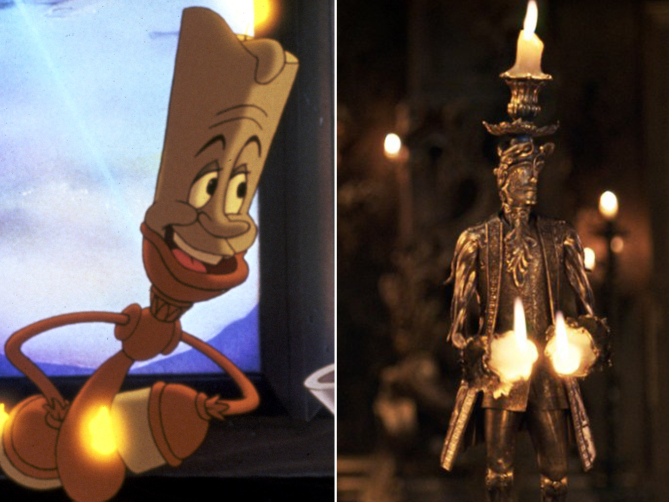
Good luck explaining sentient furniture to your kids now.
So it's set in the most British part of France apparently where only Lumiere has an actual French accent. And in a cartoon world a lot of what was deemed unbelievable could be conceivable with enough suspension of disbelief. Now it raises a lot of uncomfortable questions like can Gaston really lift two heavy-set people with his hands, and do all of the sentient object in the palace actually have human souls? I mean, it's creepy as shit.
The motion capture on Dan Stevens is basically ridiculous. He's terrifying, which kind of kills the love story which is central to the plot.
But not as creepy as what they did to Dan Stevens, that poor son of a bitch. They could have used practical prosthetics, hair and make up to make him properly beastly looking, but they decided to CGI the fuck out of him so that he looks like he was drawn by a 12 year old on a Windows 7. Also, the sentient objects with actual speaking parts have more character and facial expression in the original, than the CGI moving objects in the old palace. I don't care how good of a French accent Ewan McGregor can do.
As I said, with a few new songs added (because Bill Condon has a huge hard on for almost memorable songs that stretch the runtime), the songs are exactly the same, except they sound like cheap karaoke versions of the beloved originals like 'Be Our Guest'.
They were fun, remember them?
There is a cheap half-assed attempt to fill in some plot holes like what happened to Belle's mother? How did no one in this tiny town notice that the Beast has been beasting for like ten years? And how the hell did she get the damn Beast on the horse after being attacked by wolves. But it's so lazy, I'd rather just use my imagination. Speaking of which, I remember that as a kid, you really did fall for the Beast and understood why Belle would too, but in the live-action version he's so CGI'd to death that there's nothing remotely attractive about him.
I'd also like to touch on the controversy surrounding La Fou as the first openly gay character in the Disney-verse. In this great article it actually surmises that La Fou is a piss poor tribute to the gay community. He basically meets the somewhat offensive and stereotypical gay tropes like an effeminate manner, and a one-sided crush on Gaston that's never really nuanced, but apart from that he's the gay comic relief that you expect in a film from the 50's that's more ignorant than anything else. He gets like one sincere moment that would make him a genuine gay character, but that's all that Disney allows him. Lest we forget that his name literally translates into 'the fool'. C'mon Disney, you had more going with Ursula or the Sherif of Nottingham.
I guess I missed the take-acid-now instruction prior to this scene.
Bottom line, this remake is not only useless, but it's superfluous. Apparently Disney couldn't leave well enough alone. The most iconic scene in the film; the ballroom dance scene between Belle and the Beast in that stunning yellow dress had more beautiful sprawling camera angles and lighting in the cartoon. It's like they're not even trying. If you haven't seen it, just watch the original and pretend it's in live action.
There are a select few people in
film that I can say are flawless, and even less that I can say I admire to no
end. One of these lucky people (were he alive I’m sure he’d be so flattered to
hear that) is Orson Welles. On the anniversary of his infamous 'War of the
Worlds' broadcast, I’d just like to pay homage to him with a blog post (again,
he’d be overwhelmed with flattery) about three of the most significant things
he ever did.
When he first came to Hollywood
they nicknamed him the ‘wiz kid’, the ‘boy genius’. At 24 he had already
conquered the fields of theater, radio, what was left for him to tackle but
film? Ironically, considering his freshman effort Citizen Kane is considered to
be the greatest film of all time, Orson famously said that he doesn’t even like
films and doesn’t see many of them. It just so happens that he was such a genius
that whatever he touched he not only succeeded in, but became the master of.
He came to Hollywood with a beard
and a ‘fuck you’ attitude that infuriated everyone, especially when they
learned that he refused to play by their rigid rules. He was the youngest
person in history at that time to have a do-whatever-you-want contract with
RKO. This was unheard of. Imagine, a studio with thousands of employees and a
solid reputation are entrusting everything to this kid who’s never made a film
in his life. They banked on the right horse. But as you’ll see, it came with a
very serious backlash, for the studio and their golden boy.
As I said, I think there are
three significant points in his life that changed it and the world as we know
it. All of them happened before he celebrated his 25th birthday. Do
you feel like a failure yet? Anyway, here they are.
Enormous crowd outside the Lafayette theater on the opening night of Macbeth.
First there’s the ‘Voodoo
Macbeth’. Quick and term-paper like backstory. In the midst of the great
depression, FDR signed for a program called the WPA (Works Progress
Administration), to help people find work. A fraction of which went to the
arts; particularly the FPA (Federal Theater Project). Orson saw a chance, and
at 19 went to Harlem to audition many African American actors
to read Shakespeare, the majority of which had never even been on a stage
before. But with Welles directing them, he made what’s known in
theater circles as one of the greatest theater productions of Shakespeare ever
made. That’s ever. It opened before he turned 20. One critic described it as
‘chaos, but very carefully contrived chaos’. Clips of it actually exist and I
believe you can youtube them. Somehow, this kid who had never directed anything
outside of school could get non-actors to recite the words of Shakespeare like
they’d been preparing for this performance their whole lives. After that I
don’t have to tell you he was the shining star of the FPA. He went on to direct Julius Caesar, which was more critically and commercially successful
than the Voodoo Macbeth, but I think that considering the circumstances, the
Voodoo Macbeth is definitely one of his greatest achievements. There are some
actors from it that are still alive and when interviewed, are still astounded by
what they experiences in working with Welles. Not only did it generate
publicity for Welles and give hundreds of out-of-work African Americans jobs,
it put a spotlight on the FPA and the importance of the arts even in the midst
of a depression. If only we could see that now and not nix arts first when we
run short of cash in classrooms.
Seriously, the whole play was recorded. The sound kind of sucks and picture quality is sub par, but the content is worth it.
The second was a year later.
20-year-old Welles was already an established radio actor with that baritone
bellowing voice. He was so popular that he actually hired an ambulance to drive
him around New York City so he could make it to every recording no matter where
because he figured out that there was no law that said you had to be sick to
travel in an ambulance.He finally
decided to take this a step further. As a child, he loved magic, and was a
skilled illusionist. Now, he was ready to drop his biggest magic trick on the
world. He chose the classic H. G. Welles story 'War of the Worlds' as his
source material, he decided that he would broadcast it, with all of the
showmanship and drama that only Welles could manufacture. He did not broadcast
a disclaimer before it saying ‘this is just a reenactment’, but went full force
with the story, landing his Martians right in the middle of America’s
dinnertime. He knew that the most popular radio show at the time was one that
would cut away to some commercial every now and then, and used those intervals
when people were changing the station to put the whole nation into a state of
panic. He stood in the middle of his radio actors with a long conductor’s stick
and cued everything with the precision of a surgeon. If you listen to the
broadcast (you can buy it on iTunes), it’s unbelievable. You can’t blame anyone
for actually buying the fact that they were being invaded by aliens and the
world is in a full on panic. He plays a newscaster that narrates a horror he
sees in front of him with people screaming in the background. ‘People are
flocking to the East River, thousands of them’ he would report as the chaos
continued and just when it reached its zenith, he went silent.
The infamous pause that Welles held, and everyone in the studio as well as across the country held their breath.
Everyone was
literally glued to their radios at that point because they thought that the
broadcast had been discontinued and the employees eaten by Martians. People who
participated in this broadcast remember the image of Orson standing there with
both hands in the air, holding that silent pause as long as he could. Even they
were relieved when he finally started speaking again. Welles later said of the
incident that ‘most people would have been thrown in jail for that, and I got a
Hollywood contract’. After the truth came out, and Welles had a press
conference where he played dumb saying that he had no idea that the nation was
taking the broadcast seriously, everyone in Hollywood understood that this is a
man who could put on a serious show and get everyone’s attention. With two
amazing achievements under his belt, his next logical step was to conquer the
movie world.
Welles directing Kane, smoking a pipe which Hollywood also inexplicably hated.
Ergo his third greatest
achievement. At 23, he arrived in Hollywood with a contract that no one had
ever heard of; total creative license and access to whatever he wanted.
Hollywood vets like John ford and Cecil B. Demille hadn’t ever seen such
leeway, and they gave it to a kid who’d never made a movie in his
life. Fortunately for him, he had a lot of help. A wealth of seasoned
professionals helped this cinema neophyte create what we now consider to be the
greatest film of all time; Citizen Kane (1941). Gregg Toland came into Welles’
office one day, plopped his Oscar down on his desk and said that he would be
honored to photograph the picture. His childhood friend Joseph Cotton was
already a respectable actor when he was cast as Kane’s best friend Jedediah
Leland, but there was no question who would play Kane himself. At that time,
Welles began hanging out with renowned screenwriter Herman Mankiewicz; a
talented, shrewd writer with a huge alcohol problem.
To achieve those iconic low angle shots that accentuated the figure in the frame as being incomprehensibly tall and powerful, Welles and cinematographer Gregg Toland tore up the floor of the set and mounted the camera in the hole.
During one of their
drinking binges, Mankiewiecz spilled the beans about his frequent trips to San
Simeon. San Simeon was the home of newspaper tycoon William Randolph Hearst. It
was literally a castle; the property on which it sat (also owned by Hearst) was
half the size of Rhode Island. There was a veritable plethora of juicy gossip
Mankiewicz disclosed to Welles and a light bulb went off in his head. After sitting
on his ass in the hot California sun for months at that point, Welles finally
figured out what the boy genius would do for his first film. He’d make the
story about a gargantuan figure; the embodiment of the American dream; a man
who has everything, except a soul. He was smart enough to thinly veil the story
by giving his main character a different name and setting the castle in Florida
instead of in San Luis Obispo where San Simeon was, but that was basically all
he changed. You’ve seen the film probably so I’m not going to get into plot or
anything…if you haven’t my god what’s wrong with you? Anyway, what happened in
the aftermath was something not even Welles could run from. Gossip columnist
and devoted slave of Hearst, Louella Parsons, demanded an early screening and was livid by the
end of it. She immediately told Hearst that it was all about him and painted
him as a bitter old lunatic, alone and alienated in his giant palace full of
‘stuff’. But what really stuck in Hearst’s craw was the depiction of his then
mistress, later wife actress Marion Davies, whom they painted as a gold digger
and a whiney floozy; a party girl without much of a brain. Hearst knew how much
power he had and showed up in every studio head’s office with a thick folder of
scandalous news that he had kept out of his papers as a favor, threatening to
reveal all of it if they dared release Citizen Kane. He wanted every single
print burned, and the studio heads had a meeting where the general consensus
was to comply with Hearst’s demands. After all, they didn’t want orgies,
hit-and-run accidents, and the fact that they were all Jewish to come out. That
last part isn’t even a joke. Hearst literally threatened to expose that fact,
which apparently back then wouldn’t be so great. Oh the blatant racism of those
times.
Hearst and Marion Davies at one of their many costume parties at San Simeon. Apparently if you were a movie star and invited up there and didn't go, the order would go out, and your name was kept out of every Hearst paper. Enjoy this ridiculous party, I command you!
It was 1940 and Europe was
engulfed in the Second World War. With Hitler and the Nazi party being the
constant diet of the newspapers, Welles used this to counter their decision. He
made the argument that at a time where there is no freedom of speech and
blatant persecution of races, religions, and political groups in
Europe, that they couldn’t possibly do the same thing in America. After all, we
stand for something…even the studio heads. They couldn’t deny he was right and
RKO released the film in 1941. The critics loved it, the public loved it, but
it didn’t matter. Hollywood still hated and resented Welles for being so
arrogant (considering he had total license to be) and the film was completely overlooked. It had a regular run in theaters and really didn’t gross that much.
At the Academy Awards that year it won only one Oscar for Best Original
Screenplay, which was really an award for Mankiewicz even though it was shared
with Welles. It wasn’t until Andrew Sarris and other critics, particularly from
Cahier du Cinema and the general French New Wave, started mentioning it as their
favorite film that it became relevant again and now we all know it to be that
really amazing film that we just haven’t gotten around to seeing because it’s black
and white, long, and dated. Fuck you, watch it.
Well there’s the three. After
that, Welles’ career became somewhat of a black hole. No one wanted to neither
hire nor work with him. His ego preceded him and everyone basically said;
‘thanks but no thanks’. By the time he was 30, he looked about 50, was about
100 pounds overweight, and totally box-office poison. He had played by his own
rules his whole life, and everyone allowed it, everyone except Hollywood. Then
and still, they have a ‘it’s my way or the highway’ sensibility. And Orson chose
the latter. He died miserable and alone, because being Orson Welles, he couldn’t
even make a marriage work considering that in his life, it was always Orson Welles who came first. But that doesn’t matter. Even though the majority of his life
was a decline, this is a man who had accomplished things we can only dream of
doing perhaps once in our lifetime. He did 3 before he was old enough to rent a car.
The legacy he left behind remembers that. We didn’t hear much about Welles
after he turned 30, because we remember him as that ‘boy genius’ that turned
everything he touched into gold. Yeah he was difficult, yeah he was
self-obsessed, yeah he was probably an asshole…but above all, he was
perhaps the greatest genius of the 20th century; a renaissance man
who could take on anything, except his own demons. In my life, I don’t think
anyone has influenced me more than Welles. He didn’t set any new standards
because his standards are totally unachievable. But he did gift us with his
talent, which is literally incomparable, and even 70 years after his golden
age, there has been no one that has come anywhere close.
As some of you know, I have a definitive top 250 films list. And as less of you know, I'm a fickle bitch and I change it whenever I have time. But the top 10 remain the same somehow. Because I have no life, this is something I'm constantly tweaking and would like to share it with you now, not all 250 that's just rude, but how about just the top 10. I'm sure everyone who loves films have their own, and hey if A.O. Scott can put one out every year why not me? Because he works for the New York Times is why. Hurray for free blogging! Here we go. Remember it's totally subjective, but also very real. Before we go any further, I'm a film snob, so be forewarned.
1.La Regle du jeu
"The Rules of the Game" (Jean Renoir) 1939
Jean Renoir could perhaps be the
greatest filmmaker of all time, he’s not my personal favorite, but this puckish
satire about the Euro-upper class in between the two world wars is a subtle
masterpiece in artistry, writing, and a scathing commentary on the human
condition. A comedy of manners if you will, with brilliant performances and
with Renoir at the helm, it’s nothing short of a masterpiece. It's a timeless commentary on how decadence, self-indulgence, and arrogance is inevitably the end of our souls, but when clouded by money and cocktails, we can go on not caring forever.
2. The Third Man
(Carol Reed) 1949
On the heels of Citizen Kane,
Orson Welles put in arguably his best performance on screen, in what he
referred to as a ‘star role’. His character doesn’t appear until the end of the
third act, but is talked about throughout the entirety of the film. Set against
the bleak backdrop of Vienna right after World War II, he’s teamed up with his
bestie Joseph Cotton who acted opposite him in Kane in one hell of a mystery
caper with one of the best twist endings of all time.
3. Some Like it Hot
(Billy Wilder) 1959
I just blogged about Wilder, so
what can I say. All of his films found a place on my top 250, but this one
ranks highest because I’ve never in my life experienced such a perfect comedy.
It’s a constant stream of set-up to punch line, and not one time is it not
funny. From the writing to the indelible performances from Tony Curtis, Jack Lemmon and Marilyn Monroe, it is consummate in its perfection.
4. Fanny och
Alexander "Fanny and Alexander" (Ingmar Bergman) 1982
As with Wilder, there are quite a
few Bergman films on my list. I honestly don’t know why I prefer this one above
the rest, it’s of his later catalogue, where most would say he started
slipping, but it’s so deeply personal and so artfully crafted that I believe it
to be his best. And if you have 5 hours and about 130$, you can watch the
unedited version on Criterion.
5.8 1/2 (Federico
Fellini) 1963
What can I say about Fellini,
Wilder may be my favorite director, but Fellini is whom my heart really belongs
to. Here’s a man who said, what does it matter, it’s only life. A man who’s
films reflect not his reality but the endless bizarre nature of his
imagination. This film is his most self-indulgent considering it’s basically
about him not being able to figure out what to direct next, so he wrote a film
about it. But with Fellini, it never feels self-indulgent. His attitude is so
carefree and whimsical towards filmmaking, though on set he’s known as a bit of
a dictator, that every thing he directs seems like a gift.
6. La Passion de
Jeanne d'Arc "The Passion of Joan of Arc" (Carl Theodore Dryer) 1928
This film was band in almost
every country upon release and the director died thinking the last print had
been burned and his greatest masterpiece never to be seen again until by some
miracle it was found in the insane asylum closet in Holland. Turns out the
doctors had ordered it when it was still legal, and forgot about it. Historians
and archivists slaved to not only put it back together but to restore it so
that we could all bask in its glory. I have no idea what the film community
today would be without it. It’s more than a film; it’s a piece of history.
7. A Woman Under the
Influence (John Cassavetes) 1974
John Cassavetes is perhaps the
one director whom I think anyone should aspire to be like. Known as the
paragon of the American independent film, this actor turned director would
take no salary, and work on improve with his wife Gena Rowlands and his small
group of acting buddies on a story that they would later film in his apartment.
This story of a woman quietly unraveling is so gut wrenching that it absolutely
eats away at your core even if you can’t relate to it. To be able to do that is
what separates the hacks from the artists. Besides, if I didn't put this film on the list, my mother (who is Gena Rowlands' #1 fan) would kill me.
8. Cabaret (Bob Fosse) 1971
Yay! A musical. Me personally, I
worship the ground Bob Fosse walks on. This was his first feature and has
become iconic since. Films like Chicago, Burlesque, basically any musical that
exists today borrow from its aesthetic. Fosse was the first one to use editing
to free the dancer from gravity rather than shooting them on a presidium arch
like we see in the 50’s. Taking place in the troubled Weimar Republic of Berlin
between the two wars, it concerns a lowly cabaret performer (Liza Minelli) but
really is a social commentary on people’s desperate need to remain ignorant,
coupled with some of the most memorable choreography and musical numbers in
film history. It’s definitely my favorite musical of all time, and though there
will never be another Fosse, it’s fun to watch people try.
9. Ladri dei biciclette "The Bicycle Thieves" (Vittorio De Sica)
1948
If you went to film school, read
critic blogs or know anything about the catalogue of classic films, this film
usually is seen as #1. It’s the birth of the Italian Neo-Realist movement,
telling the heartbreaking story of a desperate father in post-war torn-apart
Italy who just wants to be able to take care of his family. If the world was
ending and we had only one film to put into a time capsule so the mutants in
silver jumpsuits would know what cinema was, we would throw a copy of this
one into it.
10. Notorious (Alfred Hitchcock) 1946
I know I’ve said that Rebecca is
my favorite Hitchcock film, but this is in my opinion his ‘best’. Best and
favorite are vastly different. It stars two of his favorite collaborators;
Ingrid Bergman and Cary Grant as star-crossed lovers in a spy thriller that
with it’s signature Hitchcockian flair will put you on the edge of your seat.
This is the film that in my opinion defines Hitchcock as the Master of Suspense
and cements his status as an auteur.