Showing posts with label Academy Awards. Show all posts

Thursday, April 12, 2018

Ingrid Bergman As the Forgotten Catalyst of the #MeToo Movement


After a loooooong hiatus, probably the longest one I've taken because I just didn't know what I could say in a world of more turmoil than most of us can handle. Example: My last post was about gun control and how it's intimately tied to nationalist seeds that were planted in the 90's when there was too much domestic terrorism going around. Interestingly enough, this wast in response the Charlottesville rally, way before #NeverAgain and the shootings in Parkland and subsequent student outcries and marches. It's as if the minute you think of something important and culturally appropriate to write, something else happens before you type your first sentence. Our world under the Trump administration is 'sour cream in the sauna' as Patton Oswalt put it. The minute you think you have something important to say about one catastrophe another one comes around and that one becomes moot. And after a while you're depressed thinking; what's the damn point? However this blog was started about film tv and the media, and in my account I noticed many drafts that I started but never finished; about Taylor Swift's new ridiculous album where she reinvents herself and contradicts herself at the same time and why do we care ...the brilliance of the Ryan Murphy machine and why I believe that American Crime Story: The Assassination of Gianni Versace contrary to popular opinion was actually pretty brilliant. But I had lost my mojo. Sounds better than I'd lost my will to give a shit. 
Today a movie I had heard of, but had never seen was on TCM and I watched it because I love (I was about to say 'old movies' but that's so disrespectful) The Golden Age of Hollywood and everyone knows how much I geek out on that shit. I had heard the psychological term that was taken from the title of this film, surprisingly from my therapist but never really understood what it was about until I watched the film Gaslight (1944). It stars Ingrid Bergman in an Academy Award-winning performance, Charles Boyer, and Joseph Cotton. Because it's a 1940's film there has to be an angle and an actual diabolical plot, but I can see why the term 'gaslighting' comes from the film. For those not in the know, first of all good for you ...but we've probably all been gaslighted in one way or another, usually by a person close to us and intimate in our lives. It means when a person systematically and psychologically wears you down and makes you mentally weak; making your ability to recognize your decisions, your opinions, and your very relationship to reality to be questioned. Ingrid plays the victim of gaslighting before psychological therapy was even a thing. What really got to me was that Bergman is able to not necessarily recognize what is happening to her, is able to get away (with male help) but still. 
A beaten down, psychologically exhausted Bergman shows in her eyes that she's had enough. 
Most people, when they think of Ingrid Bergman they have the picture from Casablanca (1941) in their mind when an emotional beauty asks Humphrey Bogart how she will go one without him and he just hold her chin and says 'we'll always have Paris.' Then she waves at her one true love through a fog as she climbs on a plane that will take her to safety. But her career has taken a turn for the more inadvertently sociopolitical since then.
Then it made me think of other Bergman films and realized that there is a fundamental feminist thread inadvertently running through her film career and her roles. She almost always plays a victim of some kind of psychological torture. Another famous example is Spellbound (1945) directed by Alfred Hitchcock and co-starring Gregory Peck, where his character has amnesia and she plays HIS therapist and to get him to remember his past correctly she must travel to the darkest depths of his subconscious and risk her own sanity in the process. 
Moving to the 50's, she at that time had been ostracized by the Hollywood community for leaving her family to marry Roberto Rosselini and have children with him. It must've hard to be blacklisted like that for personal decisions. Yul Brynner costarred with her in Anastasia (1956) for which she won her second Academy Award (and not her last one), and he in fact said that unless she was cast, he wouldn't do the film. She (again) plays a woman with many psychological dysfunctions and appears to be weak emotionally and mentally. And yet, she always overcomes, and how more feminist can something like that be, even in those times? When the patriarchy is not only not in your favor, but is telling you that everything you say or do is wrong, and you have the courage to stand up to that and say; I don't care. I know who I am and you can stop trying to take that away from me. 
A woman found about to kill herself on the banks of the Siene River is rescued by Yul Brynner but through her own initiative takes her rightful place among what she knows is her destiny. 
It was cataclysmic in the 40's and 50's. Most people would point out Katherine Hepburn or Marilyn Monroe for being so overtly opinionated and strong whether they use intellect or their sexuality as their weapon, but to look at Ingrid Bergman and her behavior both on and off the screen would make her at the crux of the #MeToo movement. 
To back track just a little. My favorite film of hers was always the Hitchcock film Notorious (1941) where she plays opposite Cary Grant as a spy. Here's the background. Her character Alicia a party girl and quite the drunk, which is understandable considering her father was just prosecuted and jailed for Nazi war crimes and she wants nothing to do with him or his affiliations. To redeem herself, she is offered a job by the American government as a spy to infiltrate a Nazi collective in Argentina and is made to go further and further into the inner circle until she is proposed to by a Nazi war criminal. She decides for the sake of the mission to accept, throwing herself into greater danger. Once her husband discovers that he's married to an American agent, he and his mother decide to slowly poison her so that they can kill her but it wouldn't look like murder. After a while, she gets wind of exactly what's going on but decides to see the mission through, and it is only because they have weakened her so much physically that she is unable to save herself and Cary Grant has to swoop in and literally carry her out of the house to safety. 

Adapting a more androgynous look, trying futility to hide her incredible beauty, Bergman knows that she is a pawn in a game between covert operations by the United States and the clandestine Nazis in Argentina and still fully throws herself into danger, because she can handle anything anyone throws at her in Notorious (1945). 
But her gall, fearlessness,  off the wall intelligence and intuition, is absolutely astounding in this film. I wish every young girl can see any of Bergman's work because she was a role model without even knowing it. Yes, she did what she wanted, and she put every part of herself into her very complicated roles and left her blood and sweat on the floor. She did it with class, with grace, and with an unshakable sense of assertion. She brings strength to very vulnerable characters and gives women a voice and a dignity in an era when that was most usually overlooked. She gave women a great role model whether she meant to or not, and she did it over 60 years ago. She did this by being hyperaware of the type of woman she wanted to be and to portray, and did it with absolutely no fear. She's not trying to be 'as good as a man'. She's being a woman, and a woman who is stronger and better than a man could ever aspire to be.

Some clips below to entice you: 


Sunday, December 25, 2016

On Christmas Night I'm Watching Schindler's List

The famous girl in red who serves as a catalyst in the change within Schindler's attitude, symbolizing every Jew he wasn't able to save. 
Let's put everything aside for the moment; Spielberg's first Academy Award, the event that it was that everyone saw, how important it is not only to the Jewish people, but for the world at large, etc. I want to talk about the filmmaking, because if I talked about absolutely everything, I'd never finish this post. 
Most of all, let's talk directing. Spielberg said his decision to shoot in black and white was because he didn't want to 'prettify' any images of the Holocaust. Apparently the studio insisted for a while that he shoot in color, and he assured them that if that was the case, he wouldn't have made the film. The lights and shadows harken to something out of Orson Welles. His long time DP (Director of Photography for the layman) Janusz Kaminski is truly a paragon of his craft. He made the events of the Holocaust and the events in Schindler's life so seamless as he moves from shmoozing with Nazi's in the first scene, the the chaos of Jews pretending that they have 'essential' factory skills so that they would get a blauschein (a blue card) meaning that they could go to work for Schindler (Liam Neeson) instead of being loaded up into trucks headed for death camps. His fluid camera captures the most aggressive and most intimate moments ranging from the liquidation of the Krakow Ghetto to a conversation between Schindler and his wife. 

Itzhak Stern played brilliantly by Ben Kingsley as Schindler's accountant and de facto right hand man. Their exchanges range from the mildly intellectual comic banter to some of the most harrowing moments of the film. 
As a historical epic (and that's what it is, not just a bio-pic), Spielberg utilized suspense so brilliantly it astounds me even today, considering that I've seen the film way too many times (like there even such a thing). A very iconic example of this is when Amon Göth (Ralph Fiennes) stands atop his balcony with a rifle killing people off one by one. He's aiming for a young Jewish boy who told him that he couldn't clean his bathtub as much as he tried. Amon tells him (as Schindler instructed when he said that power comes from pardon) that he pardoned him, changed him mind and after a few missed shots, as the kid walks away, aware of his fate, eventually gets shot in the back. 

'I pardon you'.
Another suspenful and heartbreaking scene is when a machinist gets examined by Göth, because Göth (like most Nazi's) takes his bloodlust to the extreme, and decides to kill him on the basis that he didn't make enough hinges. He knocks him to the ground and pulls the trigger, but the pistol jams. Through tears, the man tries to explain why his work was 'unsatisfactory' as Amon keeps trying to fire over and over again. Finally, he gives up and pistol whips him. The man survives, and is the one that writes the letter to the Soviets in case Schindler was captured that every Schindler worker signs on his behalf.
One of the most iconic scenes in the film of which I just spoke. It is so compelling, so terrifying, and so brilliantly executed, that it is the hallmark of perfect directing.
Now let's talk about the writing and acting. There is so much more going on than the story itself, and even with characters that have just a couple of lines, it pulls you into this film, this story, this world as if it's almost matter-of-fact. There is small humor here and there, especially with the Nazi's. A good example of this is when his accountant Itzhak Stern (Ben Kingsley) gets mistakenly put on a train to a camp, and Schindler goes to rescue him, despite his efforts, low-ranking Nazi's won't let him off. Schindler takes down their names and says; 'Thank you gentlemen, I think I can guarantee you that you'll both be in Southern Russia before the end of the month, good day'. Then the film cuts to Schindler walking along the train pass and yelling for Stern, while the low-ranking Nazi's follow him doing the same. Now that's good writing. 
But Spielberg doesn't shy away from the stuff none of us want to see, because we don't want to think that the greatest mass genocide in modern human history happened only 60 some years ago. He does this very subtly. A man sorting valuables, obviously those that Jews who are now in camps had to give up gets handed a burlap bag, inside which are a few handfuls of gold teeth. The man takes off his glasses in disbelief, as do we if we had glasses. But back to this later. 

Making the list.
A very important character is Poldek Pfefferberg (Jonathan Sagall) who actually wrote the book that the film is based on. He survived from the start of the Holocaust to the liquidation of Krakow to standing next to Schindler as he says a tearful goodbye to his workers at the very end. He is a rogue character. The first time we see him, he's mad at another seller on the black market for giving him shoe polish in glass containers instead of metal and threatens his co-conspirator. Schindler overhears his tenacity and offers him a job buying things on the black market that will be needed to shmooze with more Nazi's and eventually trade for the lives of his Jews. His mass fortune which was made by profiteering off of free labor from Jews at his company, he eventually gave up to save everyone he possibly could. 'They say that no one dies here, they say your factory is a haven, they say that you are good' a woman tells him who is desperate to bring her elderly parents into Schindler's factory. She dresses up in fancy borrowed clothes and puts on rouge and lipstick to appeal to Schindler. At first, he's furious at the fact that he's considered a Moses among the Jews, but his conscience catches up with him and he trades his cigarette lighter, his cigarette case, ties, pins, suits; everything, for his own humanity, and for theirs. 
Moreover, this is not a film about Schindler, and it is not a film about the Holocaust either. This is a film about history. A history that has been preserved in survival accounts, photographs, testimonies, etc. But someone had to put the pieces together and give us a narrative that not only educated us, but touched and enlightened us. The chaos, the deplorability, the horror, and the sorrow birthed a film that in itself is history, which taught us a very important thing through its fly-on-the-wall aesthetic; That (as the ring that the surviving Jews give to Schindler says) 'He who saves one life, saves the world entire'. 
'It's Hebrew from the Talmud, it says he who saves one life saves the world entire'.
Even watching it now, after so many times I can't even count, there are moments of terror, moments of contemplation, anger, but mostly moments of awe in the worst way. This is our history, not just the Jews, but all of us. A time where survival was more important than any sort of life, where hiding in excrement  meant the difference between life and death, where there was real evil in the world, and eventually the righteous  triumphed over it. This happened, and no one has ever or since brought it to film more comprehensively, with more brevity, and with such a sincere heart. 

Below some related clips: 


Tuesday, December 20, 2016

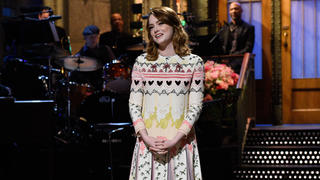
Emma Stone: The New Old It Girl

A take on The Virgin Mary (which was also a hilarious SNL sketch)
I haven't blogged in a while, and there's a good reason for that. My last blog was around Halloween, and then the election happened, and I don't know about you but I'm feeling just generally down no matter how many Samantha Bee or Seth Meyers I catch on the Youtubes making fun of this catastrophe.
Yeah 2016 in hindsight was a giant garbage fire. I'm not going to go that far into it, we all know what I'm talking about, but one source of comedy still stands strong and will continue to. The show has been on the air for 40 years and counting. Have you guessed it yet? I'm talking about SNL. You hear me Trump? You hear me racists, bigots, electors, Kellyanne, Mike Pence, Steve Bannon? We're still here, and we still have right to laugh. Ok, enough of my soap box rhetoric. On to some frivolous entertainment musings.
Everyone (especially young white pre-pubescent girls) want to be BFF's with Jennifer Lawrence. She smokes weed, she drinks Two Buck Chuck, she just doesn't give a fuck. In fact she makes such a point not to give a fuck that it's coming off as disingenuous.

Emma hosting SNL for her third time two weeks ago. 
The other day she got some much deserved heat because homegirl loves to run her mouth about all of the weird and embarrassing situations she finds herself in that are usually endearing but not in this case. Long story short; she said that she scratched her ass on sacred rocks in Hawaii where they were shooting Hunger Games: Catching Fire, so hard in fact that she dislodged a giant boulder which rolled down the hill and almost killed the sound guy. She thought it was hilaaaaaarious. Not so much. Also her movies are getting ridiculous. Yes she was Katniss, yes she has an Oscar for a film I really love; Silver Linings Playbook, but that was a while a go, and frankly Passengers looks pretty sweaty to me.
A couple of weeks ago Emma Stone hosted SNL for her third time (not for nothing, but when J-Law hosted it, it was crazy awkward and just proved to all of us that she's not as funny when on-script). In my opinion, it was the best show of the season so far, and one of the best of the last few years. Emma, like Jen seems older than she actually is, perhaps wise beyond her years, but she's quiet, demure, and doesn't pound our heads into the fact that she's JUST LIKE US. She's not.
But she's very very funny. Granted it's not just her, the new head writers at SNL gave her a great script, and she killed it. From the candle song to the cleaning crew Christmas songs to the high school obnoxious improve sketch that I love so much, she was fabulous. Oscars aren't the measure of a good actress. Case and point: Gena Rowlands STILL doesn't have one, and Marisa Tomei does. Explain that logic to me, you know what? Don't. But Stone's performance for which she was nominated (Birdman: Or the Unexpected Virtue of Ignorance) was a really solid and visceral performance. She has a quiet lightning inside of her, and it doesn't help that she's gorgeous. She doesn't have to change her look, hair color, or wear Dior couture all the time (sorry another jab at Jen). She's just herself, and with La La Land coming out worldwide next week, it seems like she's rising while Jen is slowly descending on the ladder of hot young it girls.

Lest we forget, Stone was tapped to play perhaps the greatest female character ever written; Sally Bowles in the 2014 Broadway revival of my favorite musical; Cabaret.
With so many examples of faux white girl feminism that are so obnoxious that they crawl under my skin and make me nauseous; like Taylor Swift and her stupid squad, Lena Dunham and her show that she doesn't even write anymore, I could go on and on but I don't want to. In this climate, I would rather have a friend like Emma who has it together and seems eons smarter both streetwise and intellectually than Jennifer, despite the fact that both are high school drop outs. It just seems that Jennifer peaked a while ago, and now she's the highest paid actress in the business. We as snarky critics can say it's because she sold out, but that's not snark, it's just the truth. Emma continues to pick interesting and unique projects and can go from Spiderman to Birdman to La La Land seamlessly. Btdubs her chemistry with Gosling is too ridiculous. I'm sure he can have chemistry with a gardening tool, but still. I've switched teams, and I'm excited to see what Emma does next. Keep in mind, she started out in the Frat Pack opus Superbad as Jonah Hill's love interest. Let me say that again: Jonah Hill's love interest.
Her performance in Birdman was pretty untouchable. She didn't have that many quips or clap trap monologues, but her down-to-the-bone performance as a lost and confused former junkie daughter of a washed up has-been actor almost stole the show. Almost, because stealing from Michael Keaton is pretty damn hard. A for effort. 
I'm not even going to touch on Margot Robbie who is probably the best and smartest actress under 30 right now, and though it would be fun to throw a monkey wrench into this agenda, I like pinning two actresses that are around the same age and with the same influence on the zeitgeist against each other for shits and giggles. It makes me feel better about myself. And in a time when we desperately need some escapism, Emma delivers. Also, Jen stop scratching your ass on sacred rocks, it's not funny and it's flat out disrespectful, crude, and ridiculous. We're the fairer sex for a reason. Enjoy your free drinks.

Below some SNL clips and La La Land Trailer:


Saturday, September 24, 2016

In Memoriam: Curtis Hanson, The Quiet Intellectual

Curtis Hanson
In case you missed it (you probably did, what with the first Clinton/Trump debate coming up and the riots in Charlotte, and of course Brangelina splitting up), filmmaker Curtis Hanson passed away last week. Now that last sentence makes me sound profoundly shallow, but I try to have tunnel vision into what's going on in pop culture, and I'm sure I'm late AF to the Brangelina party, just like I missed the Hiddleswift split party, and it's too late for my Best/Worst dressed list for the Emmy's (Sarah Paulson took my breath away). 
Alas, this is not to be overlooked. Not very prolific, and always a bit under the radar, Curtis Hanson has not made many films; most of which, like him, flew quietly under the radar with one exception; L.A. Confidential (1997) which sweeped 9 nominations at that year's Oscars and lost all of them (save for one; Kim Basinger for Best Supporting Actress) to Titanic (just threw up in my mouth a little bit, it's fine). 
Poster art for L.A. Confidential
A little backstory about the film; it's based on the novel by James Ellroy who writes pulp fiction novels, for those of you who don't know the term past the Tarantino movie, let me enlighten you. From the time of writers like Raymond Chandler and Charles Jackson, there have been pulp fiction novels. They're kind of like the B Movie of books. They are seedy, salacious, and over the top; dealing with murder, a hot girl (a Femme Fatale for the expert), and a caper of sorts. They are a great read because they are somewhat easy to digest; they aren't exactly Dostoyevsky. But Ellroy took it to the next level and coupled that camp with the dingy, seedy (again), and deliciously fucked up world that is Los Angeles in the 50's. It's an insider's view; kind of like the back end of the website to the glamour facade of Hollywood; and entire industry and culture built on lies, prostitutes, dirty deals and crooked people. That's basically what the film is about. The film is probably as close to the book as an adaptation has ever been, and that's why it's confusing as hell, even for someone like me. Who's that, why is he doing such and such, wait, I though that was the good guy, wait, who even is that? Those kind of questions run through your mind constantly but you can't help but be swept away in the writing, the performance by now some of our favorite actors...among them; Guy Pearce, Kevin Spacey, and (arguably) Russell Crowe; and most of all, this nostalgia that most of us don't even remember because we didn't live through it. 
James Ellroy. He could not look like more of a pulp LA writer if he tried. 
Me? I'm a sucker for Old Hollywood. I don't know why I had to make that public and put it in writing, because most people are already saying to themselves; duh!. But hey, let's make it official. I won't go into the convoluted plot that is nuanced brilliantly and beautifully by Hanson, because as I said he had a whole filmography under his belt, among them lesser but still great films like 8 Mile and Wonder Boys. He wasn't exactly an auteur, just a really competent filmmaker. And with L.A. Confidential, he rose to being an amazing filmmaker. And some of us just need that one diamond in the rough to seal our legacy. And that he did. 

-How did you know I was a cop?
-It's practically stamped on your forehead. 
In 2005, it was my first year in New York, I had just transferred to NYU where a professor took a liking to me (not that kind of liking ...I don't think) and happened to be on the Board of Review which meant he got to go to a lot of pre-release screenings, of which I accompanied him to many times. One of them was for Hanson's more blah films; In Her Shoes, a totally forgettable Cameron Diaz vehicle capitalizing on Sex and the City culture, with a weak script and boring plot. Even for a sub-standard chick flick it blew, but I went because I was promised there would be Q&A afterwards. But I didn't know that my professor was on first name terms with Hanson, and invited me down after everyone left so that I could talk to him. I really didn't know what to say except ask him questions about L.A. Confidential's aesthetics, themes, etc. So basically I sounded like a pretentious film student, which I kind of was at the time, but whatever.
Anyway, I think it's important to acknowledge his passing, but moreover his body of work, which yes, was hit and miss, but I believe every director, even some of the best have misses under their belt. He was a very astute and competent man, and a very talented and perhaps deeply intellectual person which you definitely saw come out even in his sub-standard films. He was that quiet New Yorker type who strove desperately to make the films that he wanted, but unfortunately didn't always get his way.

Below, some trailers and scenes: 


Sunday, July 31, 2016

What Silver Linings Playbook is Really About

Tiffany confronts Pat at her sister's dinner when she realizes she's in a sea of bullshit. 
Marketed as a romantic comedy, by the rogue director David O. Russell, that should be a clue right there. He's not exactly a by-the-numbers filmmaker. This is definitely his crowning achievement even though I absolutely love I Heart Huckabees. This might be a little difficult for me to explain because I can relate to a lot of it but here we go. 
Set in Philadelphia, a place not exactly known for dealing with mental illness by any other means than a stigma, and coming from LA where everyone is therapy'd out to the point of paralysis, I saw the script as exactly what it was. Two brilliant actors play the two 'romantic leads', who meet at first, hate each other and by the end of the movie they're in love. Common rom com trope yes? But that's not the point of the film. 
Woody Allen might stick his neuroses in every single film he directs, but those are sadly a bit dated when people were still on Judy Garland cocktails and everything was a bit Valley of the Dolls. It was a very black and white time. Either you were nuts, or you were sane, and if you were the former you had all the pills in the world to choose from, which usually made things worse. Perhaps the last film that accurately portrayed mental illness was One Flew Over a Cuckoo's Nest, which is literally set in the insane asylum, ironically where the protagonist (Jack Nicholson) is pretending to be crazy to do time in an asylum rather than prison. There you have the schism between the 'sane' and the 'insane'. Still a bit black and white, but so full of pathos and honesty, that it still holds up today. 

For these two, the best type of therapy is not in a doctor's office. 
Let's examine Silver Linings because its a film full of grey areas, and it's in those that we figure out what the movie is actually about. Pat (Bradley Cooper) is just getting out of the looney bin after 8 months because he assaulted the man screwing his wife. He's now obsessed with being 'sane' and finding a silver lining, and getting his life back together, which in itself are all insane notions considering that a psychotic break usually does not allow you to go back to everything just as it used to be. I had a friend like that. No names, but she thought she saw the light, and because she did her Master's degree in Social Work made it her mediocre mission to chain-smoke a pack a day, rearrange the furniture in her Hollywood apartment literally every single day (we were living together at the time) to keep herself busy so that she wouldn't think about drinking or getting back with her ex-boyfriend. She loved to analyze people and I was definitely one of her guinea pigs. I hated it. I hate being mentally dissected. It's bullshit. 
As I said before, people in LA are therapy'd out, so I was able to even prompt my shrink about what I thought was going on before he could even get it out. That's why I identify with the Jennifer Lawrence's character. Tiffany is a girl with a broken wing (I think that line is actually used verbatim in the film), who's husband just died, but that's not why she's considered crazy. On the surface she's actually probably the smarter of the two. Pat (Cooper) always loves to point out how she misbehaves or behaves in means that are not good 'social skills', and she immediately calls him on his bullshit. 'You say more inappropriate things than appropriate things' is one of her more famous lines. The most important difference between the two of them; both experienced trauma leading to a psychotic break, and Jennifer is the one who moved on, while Bradley Cooper still hasn't, and is completely obsessed with the past. Backstory: Tiffany's husband died; a cop in the line of duty. After which she got fired from her job for 'sleeping with the entire office'. Pat still judges her, because he thinks that he once was crazy and now he's absolutely fine. Tiffany sees this and says 'you think I'm crazier than you'. Perfect. Who is he to judge? 

'You're afraid to be alive! You're a hypocrite!' 
There's a cute exchange when they talk about all the pills that they are on and don't take any longer, but who isn't on some kind of shit these days; does that make us all crazy? Didn't you ever read 'Prozac Nation'?
The plot is in essence irrelevant. It's about two people realizing that they will never be perfect and never find the life that they once had, and the 2 hour run-time of quippy exchanges, completely blowouts, and epic shutdowns illustrates that crazy is a grey area. 
What gets me the most is how much Pat judges everyone (with the exception of Chris Tucker's character). He even gets on his dad (Robert De Niro) about being OCD, like most of us aren't. In Philly, where regularly going to a therapist is still considered taboo, he is very uncomfortable in his current state. Tiffany basically tells him the truth, it's one of the greatest Lear-esque monologues in film history. 'I opened up to you and you judged me, you're afraid to be alive, you're a hypocrite, you're an asshole'. All of these things true. 
What's most telling about this movie is that it's not romantic at all, though both main characters have great chemistry and are very attractive. You know they are going to end up together; you just do. The way they get there is a brilliant examination of life in a black and white world of sane and insane, the pitfalls and the highs and lows that it brings. At least Tiffany is self-aware. Pat eventually comes around, and only then can they be together. There is no such thing as normal behavior, and there is actually no such thing as normal. Sorry if that's crushing some of you right now, it's just the truth. And I guess Pat was right in trying to overcome his 'mental illness' by finding that damn silver lining he keeps referring to, while Tiffany was right to hate him for his hypocrisy. 
The actual romantic angle only manifests itself in the last 15 minutes of the film, because it's in the backseat for most of it.
The only rom-com element in this movie is when both Pat and Tiffany realize that (excuse the cliché) they are not perfect or normal, but they are perfect for each other. And the normalcy that they find is not a normal that is permanent or without its haptic disorders, but its theirs and they are better confronting their demons together. This sounds like love conquers all and that mental illness can be overcome by finding someone just as or even more fucked up than you, but it's not. For everything that happens between the two, it is never a co-dependent relationship and (again, excuse the cliché) they are only able to move on when they confront everything that has brought them to the mental state that they are currently living and allowing themselves to admit that they are not in fact normal, and perhaps that's actually the best thing that could happen to them.

Below: A making-of featurette. 


Monday, October 12, 2015

Are You Sure Fincher Didn't Direct This? The Red Flags in 'Steve Jobs'

'Musicians play the instruments, I play the orchestra.'
I'm just as excited to see the Steve Jobs movie as you are. A couple of things are already raising flags. Let's go down the list shall we?

1. Marketing is smoking something. Every TV spot I see for Steve Jobs starts out great. It's the titular character (played by Michael Fassbender) narrating; 'The two most significant events of the 20th century; the allies win the war, and this...' exposing the first ever Apple Mac. Awesome. I'm in. In fact, the History Channel just put the smart phone (which doesn't have to be an iPhone but come on) as the #1 invention of all time. But then it's 25 more seconds about the fact that he won't acknowledge his illegitimate daughter like he's Henry VIII or something. Who cares? No one. Steve Jobs is not a figure about whom the personal life is important. Do we care about Thomas Edison's sex capades? Me thinks not. As literally the second greatest inventor since the aforementioned Edison, Steve Jobs interests most of us as a pioneer of technology and a pillar of innovation. Why even put that in the movie in the first place? But that's a different story. The trailer is great, especially when Wozniak (Seth Rogen) asks him; 'what do you do? You're not an engineer you don't write code, so WHAT DO YOU DO?' It is great for exposition, and pretty much right on target considering no one took Steve Jobs seriously initially because he didn't really DO anything, he was a designer as far as Silicon Valley was concerned. But to market the film as a lazy Lifetime movie is just stupid. It will appeal to women, Fassbender is in it, so you don't have to pander to that demographic.

Boyle (left) converses with Fassbender and Rogen in between takes.
2. After The Social Network (2010), we all expected that the creative union of Aaron Sorkin and David Fincher would continue. Unfortunately they divorced, and out of all directors who are great at this kind of no-holds-barred bio-pic, and can handle the biting writing of Aaron Sorkin, it's definitely not Danny Boyle. I know he's made some great films; well one or two. Personally I think the man's only good ones are Trainspotting (1996) and 28 Days Later (2002). This is far too big a mountain for him to climb. Also, the film is about technological innovation as I said. Who handles that awesomely? Fincher. Which movie was so perfect it's almost subliminal? The Social Network. I'm sure we'll all be sitting there thinking; 'I wish Fincher had directed this'. This is a pretty heavy assumption, but that's what I'll be thinking. 

'I can't wait for you to think of a proper metaphor' the words of Sorkin are music to my ears.
3. In terms of award season fodder, I'm skeptical. As much as I love Fassbender, and how method he is, and basically flawless as an actor, he doesn't seem like he's the strongest performer in the movie. I really hope that this doesn't turn into a film where the main character doesn't even carry his own story. The supporting roles already seem to be played with more gusto and bravado. But all that the trailer shows me is that Fassbender has a great wardrobe department (that's a given considering Jobs famously only wore black turtlenecks and dad jeans) and has the voice down. Ergo, when it comes to the Oscars, we might see the exact kind of backlash we saw with overhyped films like The Social Network. I know all of the principals are going to be nominated, but honestly, I don't see a win in any of their futures (perhaps because I'm rooting for Eddie Redmayne in The Danish Girl and can't possibly conceive of saying 'Oscar winner Seth Rogen', but only time will tell. 

4. Just to sing Fincher's praises a bit more, I don't think anyone understands that dark side of humanity in all of us better than him. He's proved it again and again with Se7en, Gone Girl, and AGAIN The Social Network. Danny Boyle is a few clicks away from being Baz Luhrmann; as in style without substance. Fincher tells the story of a person that is unbelievably flawed but is somehow, through Fincher magic, is endearing. Boyle, not so much. Steve Jobs is in essence a character study. It's the Citizen Kane of the technological revolution; the story of a man who gains the world and loses his soul. Boyle loves spectacle, whereas Fincher loves deep and complex personal stories no matter what the setting is. He looks at the characters before he looks to the aesthetic. Boyle, in my opinion, does the exact opposite. 

Sorkin's don't-fuck-with-me face. 
5. Maybe I'm just being a nit picky bitch here, but I get frustrated when a story that is inherently American, not in a flimsy patriotic way, but where being American is so important to the story is directed by a British guy. It's like when people were outraged that Milos Forman (a Soviet defector) made One Flew Over a Cuckoo's Nest (1975), which was very clearly an indictment of American culture. The only thing is, Forman is an infallible director and he pulled it off and no one gave an argument when he, his film, and his actors, all won Academy Awards. Steve Jobs, like Marilyn Monroe and Superman, is an American icon. And the setting of his losses and triumphs highly effects his destiny. I'm not saying that Jim Sheridan, Neil Jordan, or Ken Loach can't make American movies, but have you ever seen one? I know Neil Jordan directed Interview with the Vampire (1994) but that's basically a fairy tale that's set in New Orleans. Also Neil Jordan is awesome. Boyle has proved his versatility in working outside of his cultural comfort zone with Slumdog Millionaire (2008), but I don't think that makes him an ideal candidate. Just off the top of my head, I'm thinking Gus Van Sant, Robert Zemeckis, The Coen Brothers, or probably Paul Thomas Anderson should have been in line to direct this before Boyle. But maybe it will be one of those accidental miracles like when Spielberg decided to direct Schindler's List (1994) after Martin Scorsese turned it down. Handing Sorkin's material is no easy feat ok children? It's like trying to adapt a dense but fascinating text book. Every single word, punctuation, and inflection is important. And it goes damn fast. Only time will tell is Boyle was up to the task. 

Jobs is a very 'recent' person for a bio-pic as in he didn't die 100 years ago. When he unveiled the iPhone it was a historic moment. Aside from the OJ Bronco chase, it was perhaps the most memorable moment that we all collectively watched on TV and lived through. Ergo, material is still fresh, ergo it's easier to screw up. 
Anyway, we're all excited so I don't want to piss on that. Fassbender can play anything, I'll acknowledge that. And hey it's not like distinctively American films didn't have foreigners in it; look at L.A. Confidential (1997), where 75% percent of the cast that were playing LAPD officers were Australian. It's a risky film, and I just would have liked a little bit more of a safety net. I'm going to go in watching it with the onset of a panic attack. It aesthetically looks great. This is a pejorative ya'll. When something aesthetically looks great, it usually doesn't have much else. It's the director's way of saying; I know I fucked up on the story, but look how pretty! Based on the pre-release hype, it looks like a film that grazes the surface, but underneath it all, doesn't have much soul. My shining beackon of hope is Sorkin, as he's more stubborn with his scripts than Billy Wilder. Want to change something because it doesn't 'feel' right? Fuck you, say what's written on the page. He's one of the few writers who can actually do that. So let's hope he stuck to his stubborn guns and people listened to him first, and Boyle second, if at all. 

Below, the trailer: 


Below, the actual unveiling of the iPhone at Apple headquarters in Cupertino, CA in 2007. You don't have to watch the whole thing it's long, but it is a piece of history. When we're all wearing silver jumpsuits and riding around in our hovercrafts, I'm sure we'll still be using an iPhone of some kind...model 16 that, like Google Glass, we can wear on our heads, or we'll be microchipped with. I can't wait for the future. 


A quick lesson about filmmaking brought to you by the films, style, and aesthetic of David Fincher. Seriously, in my subjective (and well informed) opinion, he's the best director working right now.


Tuesday, October 6, 2015

The Oscars are Coming Up and I Have a Bone to Pick

Todd Solondz
Let's be honest, I have many bones to pick (keep your dirty jokes to yourself). The snub list goes on and on. Can you believe that Orson Welles, Charlie Chaplin, Marilyn Monroe and PT Anderson have never won jack shit? Can you believe that Stanley Kubrick only won an Oscar for Best Visual Effects? Why is it that I keep watching this show, honestly? We all know it's so political it's almost rigged and that The Weinstein's run such expensive Oscar campaigns for their films that they are guaranteed nominations every year? Yeah, I'm saying it; you can buy a nomination if you have the money. It's clearly not based on merit, I mean come on. One anonymous member of the academy once said publicly that the way it works is that they receive all of these DVD's in the mail, with a watermark on them saying 'consider this...' Any one who has ever illegally downloaded a film (which is all of us) has seen that watermark. Anyway, he said that if they don't have the time, or they are bored, or don't get a DVD, it doesn't get watched, ergo it doesn't get voted for. A lot of the time, votes go to a person that an Academy voter likes, regardless if the performance was shitty or not. Why do you think Joaquin Phoenix never wins anything? I remember very well when esteemed documentarian Errol Morris who has been working for over 20 years on some of the most iconic documentaries in the American idiom FINALLY won for The Fog of War in 2004. The first words that came out of his mouth at the podium said it all; 'I want to thank the academy for finally paying attention to my films'. This is the man that made The Thin Blue Line and A Brief History of Time amongst a plethora of genius documentaries and only in 2004 did they finally give him the honors he well deserved. 
But my bone to pick I have to focus on one filmmaker because if I focused it on all the snubs this blog post would never end. One of my favorite filmmakers is Todd Solondz. I met him once when I was working at the New York Film Festival. I touched his arm, and I swear you guys, I saw Jesus. That's a lie, and even if it wasn't it wouldn't mean that much to me because I'm Jewish, but it was like a regular person meeting...Brad Pitt I don't know. This filmmaker has always worked slightly on the fringes of Hollywood and every film he's made has been strictly independent. Over time, he has garnered a cult following, and status as a rebel. He's quirky, funny, and undeniably weird. Even in real life he just looks like he'd rather be in his room staring into space. But this introverted man completely lacking of social skills has given us such gargantuan gifts of cinema that if only more people paid attention to, would have status as a reputable filmmaker, but he doesn't, except for his niche cult followers (myself included). 

Dawn Wiener in front of her locker at school.
In 1995, he made what I consider to be one of the best films of all time; Welcome to the Dollhouse. It concerns a lowly pre-teen loser named Dawn Wiener played impeccably by Heather Matarazzo. She lives in the whiter than white suburbs of some unknown Midwestern town, is constantly bullied by her classmates, and resented if not totally ignored by her family. Her plight as a woman (albeit a very young woman) is comparable to that of those great female characters that overcome insurmountable odds that we all applaud and shower with awards. Out of the twisted mind of Todd Solondz, this character rebels in her own very special way, which none of us would imagine anyone in her situation doing. She lusts after a popular guy that she has no chance with to the point of out right asking him for sex, almost kills her baby sister with a hammer, and has perhaps one of the most memorable and disgusting masterbation scenes in cinema. Suffice it to say she never gets her comeuppance. SPOILER ALERT: the film ends with her on a school bus driving to a summer camp her parents are making her go to, singing to herself, implying that no matter what she does, nothing in her life will change and she's doomed to be miserable for the rest of it. 
Something happened between director and star over time, because in the next series of films we learn that she has committed suicide. Solondz didn't make any direct sequels to Dollhouse, but made films about people that somehow knew about her. 

The image of Dawn Wiener in her 'sexy clothes' trying to seduce Steve Rogers has become iconic, well in niche circles.
As I said, over time Solodnz has garnered a following and with his much anticipated new film Wiener-Dog (Dawn's horribly offensive nickname in Welcome to the Dollhouse), the cast consists of much bigger industry names than when he first started working. I mean, Greta Gerwig is in it for chrissake. I just hope this doesn't mean he's sold out, but that he's finally being taken seriously. 
The only award this director has EVER won was 'A Filmmaker on the Edge' award (whatever that means) at the Provincetown Film Festival. That basically says it all. Even the Indie Spirit awards are afraid of him. If there's a filmmaker who truly displays an indie spirit, it's Solondz (and Harmony Korine) but that's a whole different story.

Solondz's biting indictment of suburban culture is hilarious and tragic.
He's a true Hollywood rebel in that unlike filmmakers that we consider to be rebellious we still constantly hear about because, yeah they are rebelling but somewhere along the line the acquiesced to the rules of the business. Solondz on the other hand, seriously does not give a shit. He barely gives a shit about his audience. He makes films about people that he finds interesting, and because he's such a social outcast, they are barely relatable, but my god they are fascinating. And whatever even the most liberal mind might deem 'too much' he'll throw into the plot. Because it's his baby, it's his project, and it's him on celluloid. Over almost two decades, this man has never lost sight of who he was, and his abiding belief in his talent as a filmmaker and dedication to his marginalized stories have brought him a success he probably never imagined or cared about. Now I know that if his fellow 'rebels' like PT Anderson, Harmony Korine, and Jim Jarmusch get no love from the Academy, it's almost ridiculous that I demand that he does. In fact, he probably not only doesn't care but doesn't want it. He does what he sought out to do and he did it on his own terms and continues to. Inadvertently, his films have become cult if not iconic. I for one definitely consider Welcome to the Dollhouse to be an integral part of my adolescence. And Dawn Wiener is just as much a feminist icon as anyone Meryl Streep has ever played. At barely 11 I was able to recognize that this was an iconoclast, and that his films though not all good were something to behold. So perhaps it's best that The Academy and basically all awards continue to ignore him, giving him total free license to do whatever the fuck he wants on film. Keep the money, the glory, and the false sense of entitlement out of his ego and away from his movies. But please acknowledge to me, and more importantly yourself, that Solondz is one of the most unique, galvanizing, and intriguing filmmakers of our time. 

Below, the trailer for Welcome to the Dollhouse.


Below, someone made a music video. Go them. 


Monday, July 27, 2015

Sins of Omission: Actors Snubbed by the Academy

We all know that the Academy Awards are more political than a presidential race, but we keep watching every year, and that's why when we fill out ballots (that is if we're really into it) we have a separate ballot for whom we secretly hope will win that we know will not because they're not in good standing with the committee, because the competition is too fierce, or they dropped too many F-bombs. Whatever the case may be, perhaps George C. Scott got it right when he straight up refused to show up to pick up his golden idol for his bravura performance in Patton and when it was mailed to him he mailed it back. 'It ain't nothing but a meat parade' he said. And it's sad but true that for the most part, actors especially are not given awards based on the actual merit of their performance, but for circumstance. Here's a list of some of the most grievous sins of omission in Oscar history. There are way too many for me to cover the entire spectrum so let's just focus on the acting categories...for now. By the way, this is just the tip of the iceberg, there are countless others, these are just the first ones that come to mind. In no particular order...


Anna Magnani got her start as an icon of Italian Neo-Realism, and made her transition into American films with the help of her #1 fan; Tennessee Williams who adapted his play The Rose Tattoo to film specifically for her. And to impress Tennessee Williams is no small accomplishment. But going back to Italian neo-realism, one has to really be something beyond method and dig into the depths of their soul so roughly that there’s nothing to do but suffer and cry through your performance so that your audience can fully understand your struggle. 

Gena Rowlands could be the greatest actress of all time second only to Meryl Streep. I would go as far as to say she’s perhaps even better, and with her director being her genius husband John Cassavetes, he worked her like a horse in a mine so that she could turn out the most heartbreaking and nuanced performances that touch on the female condition without beating you over the head with her plight. She embodied every part she played, and some were so down right complicated and layered that a ‘regular’ actress would be doomed to mess up. She is so intelligent as an actress that she knows exactly how to peel open all of those complex layers and get to the heart of her character. 

Leonardo DiCaprio was first nominated at 19 for his role in What’s Eating Gilbert Grape, since then he’s turned in some amazing performances, and some not so much performances; (We all remember The Beach) Oh you don’t? It’s because no one saw it, but as good as Matthew McConaughey’s performance was in Dallas Buyer’s Club, I think we can all agree that DiCaprio’s ballsy, spared no expense take on Jordan Belfort in The Wolf of Wall Street should have given him unquestionable rights to that golden statue. 

Joaquin Phoenix seems to be the one that’s always robbed because of politics. The Academy just doesn’t like him no matter how brilliant he can be on screen, and I’m not just talking about his Johnny Cash. Working with Gus Van Sant throughout his youth definitely gave him the right training, and even in his teens, his performances were intelligent, thought provoking, and full of swagger. This culminated with his masterful performance in (excuse the pun) The Master, but he was upstaged by Philip Seymour Hoffman in the same film. Even though no one won for that film that year. Another oversight. 

Judy Garland won some kind of fake Oscar for ‘Most Promising Juvenile Performer’ or something like that which has since been omitted (thank god), but seriously? Judy? No Oscar? I object! Not only is she a screen legend, and an icon not only of cinema but of culture itself, it seems almost criminal that this unbelievably talented shooting star never got her golden statue. 

Naomi Watts is an actress that has time, but in my opinion has already proved herself worthy of a golden statue. She was introduced to us with one hell of a bang in Mulholland Drive, and has been going strong ever since. The problem with her is that her performances, no matter how en pointe, are just not Oscar fodder. Her two nominations for The Impossible and 21 Grams are great examples of what this woman is capable of. She’s very much on her way, and she’s on the Meryl Streep track. I expect great things of her in the future, and hopefully the Academy will eventually recognize that too. 

Jake Gyllenhaal is very young and also has plenty of time, but to only have one nomination for Brokeback Mountain, and getting completely overlooked for his incomparable performance in Nightcrawler is just plain wrong. I’m sure he’ll garner a few in his career to come, but it still seems like a huge oversight. As brilliant as Heath Ledger was in the former mentioned film, I would argue that Gyllenhaal’s bare soul performance was perhaps even better. He shines in everything he undertakes. Hopefully this will get noticed very soon. 

Cary Grant was another that has that ‘thank you for your body of work’ Oscars, which is basically let’s give them one before they kick the bucket kind of awards. You’re probably thinking this is a mistake but look it up, even the iconic Cary Grant who was Hitchcock’s favorite collaborator has 0 under his belt. One of his wives once said she thought that he played the same role in every movie, and who cares? He played facets of Cary Grant; that deserves an Oscar in my opinion.

Montgomery Clift was perhaps the greatest actor of all time never to receive an Oscar, and he made no point in hiding how much he wanted one. He was ‘a serious actor’ if ever there was a more perfect example, and from his first film to his last, he turned out absolutely flawless performances. He was trained by the Lunts as a child on Broadway, then studied the method with Strassberg before employing his own personal acting coach, just like Marilyn Monroe had. But his self-destructive behavior sadly overshadowed his intense raw talent. All you have to do is watch his 6-minute role in Judgment at Nuremberg (his last film) to see the absolute raw talent of this man. 

Marilyn Monroe has 1 Golden Globe for Best Comedic Performance by a Woman in Some Like It Hot and that’s it. You might want to disagree with me here because she’s known for playing dumb blondes, but that’s only half of it. Marilyn, wanting desperately to be taken seriously as an actress, and already being established, did something totally unexpected and moved to New York to start over, mastering her craft under the watchful guidance of Lee Strassberg who later became her mentor. Watch her performances in Bus Stop and The Misfits; those are performances. They aren’t just Monroe on screen. 
Below...clips and trailers.